
The Harbourlands Conceptual Plan
Explore how the Harbourlands fit together—from Exhibition Place to Tommy Thompson Park
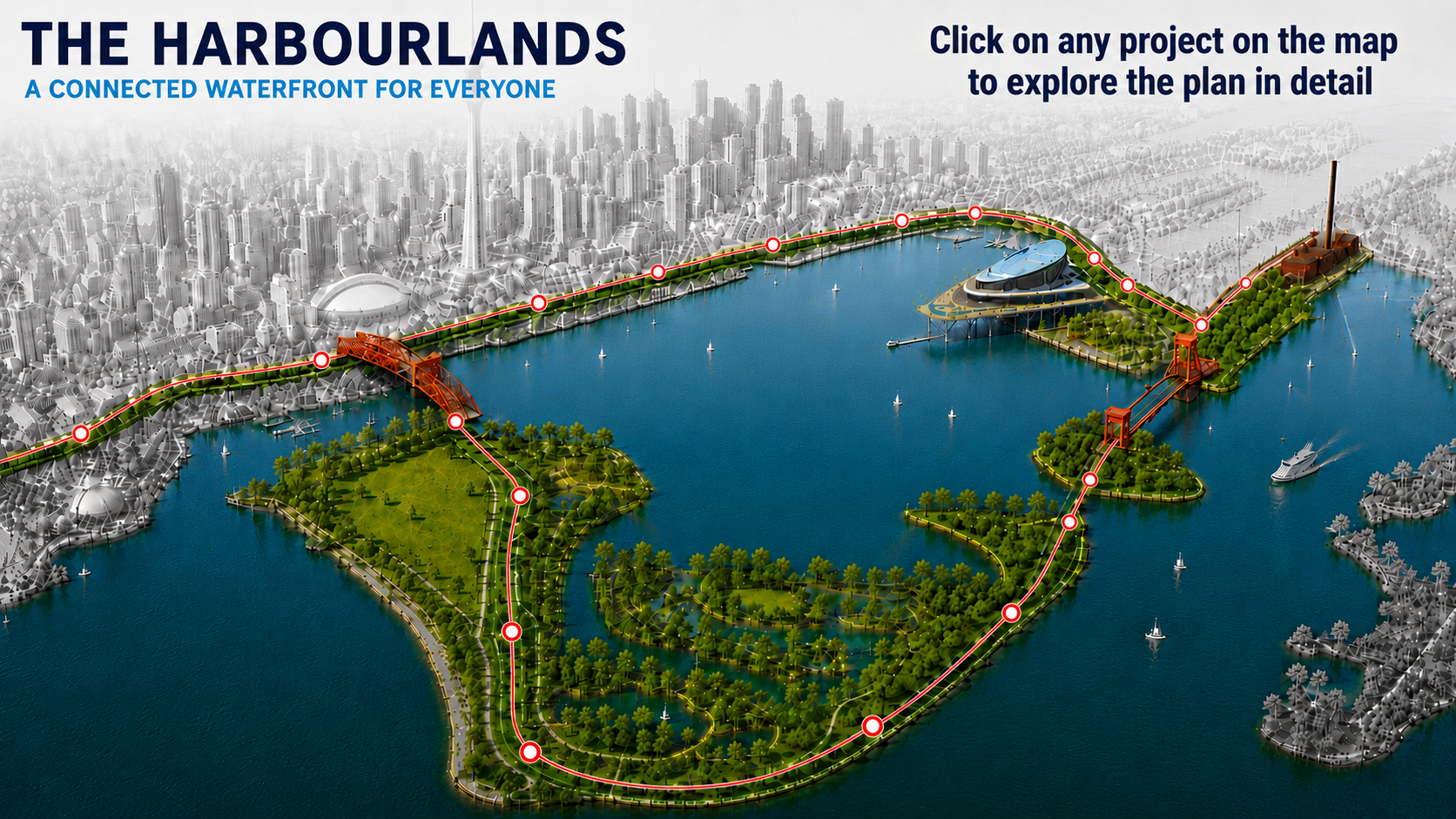
This is a conceptual framework for public discussion—not an approved plan or engineering design. Locations, dimensions, alignments, costs, and sequencing would require extensive study and consultation.
The conceptual master plan shows how the major elements of the Harbourlands could fit together. Locations, alignments, dimensions and designs would be refined through engineering, environmental, economic, and public consultation processes.
Harbourlands is a long-term plan, not a construction proposal. Its purpose is to show what Toronto could become if a future public decision is made to transition the airport lands to a new use.
The Plan at a Glance
CORE FRAMEWORK
Harbour Park
Transform the airport lands over the long term into a major public park, connecting the western Islands with the wider Harbourlands system.
Western Gap Connection
A moveable bridge carrying trolleys, pedestrians and cyclists while preserving navigation through the Western Gap.
Eastern Gap Connection
A movable bridge connecting Toronto Island Park with the Port Lands to complete the harbour-wide route.
Harbourlands Waterfront Line and Island Line
Two connected transit lines. A streetcar-based Waterfront Line from Exhibition Place to the entrance of Tommy Thompson Park and a trolley-based Island Line going right across the Island and joining the Waterfront Line in two spots on the mainland.
Harbourlands Centre
A convention, festival and cultural destination using the Toronto skyline and harbour as its defining attraction.
The Hearn
A year-round entertainment, hospitality and cultural precinct centred on the restored Hearn Generating Station.
How could the Harbourlands be advanced?
PHASE 1 — Study and protect the opportunity
Commission an independent Net Public Benefit study that evaluates alternatives including the Harbourlands proposal.
Establish a public planning process involving governments, Indigenous partners, Waterfront Toronto, residents and waterfront organizations.
Protect the option by requiring full public review before any further airport expansion or extension beyond the current agreement.
PHASE 2 — Build what does not depend on airport closure
Advance projects that do not depend on airport closure, including the Hearn District, Harbourlands Centre and transit for the Port Lands.
Prepare well before the current 2045 agreement horizon so Toronto is not forced to decide the harbour’s future at the last minute.
Complete preliminary engineering and environmental studies for the Western and Eastern Gap crossing.
PHASE 3 — Complete the connected waterfront
If a future public process approves airport conversion, decommission operations in phases and begin environmental remediation, shoreline restoration and park development.
Build the movable bridges and complete the Harbourlands streetcar/trolley and public-realm network.
One plan. Many projects. One connected harbour.
The Conceptual Master Plan is intended to begin a public discussion about how Toronto’s waterfront assets could work together over the next century.
Its purpose is not to prescribe every answer. It is to ensure that Toronto studies the larger opportunity before individual decisions make it impossible.