Why Not Expand Billy Bishop Airport?
Expansion would create a fundamentally different airport
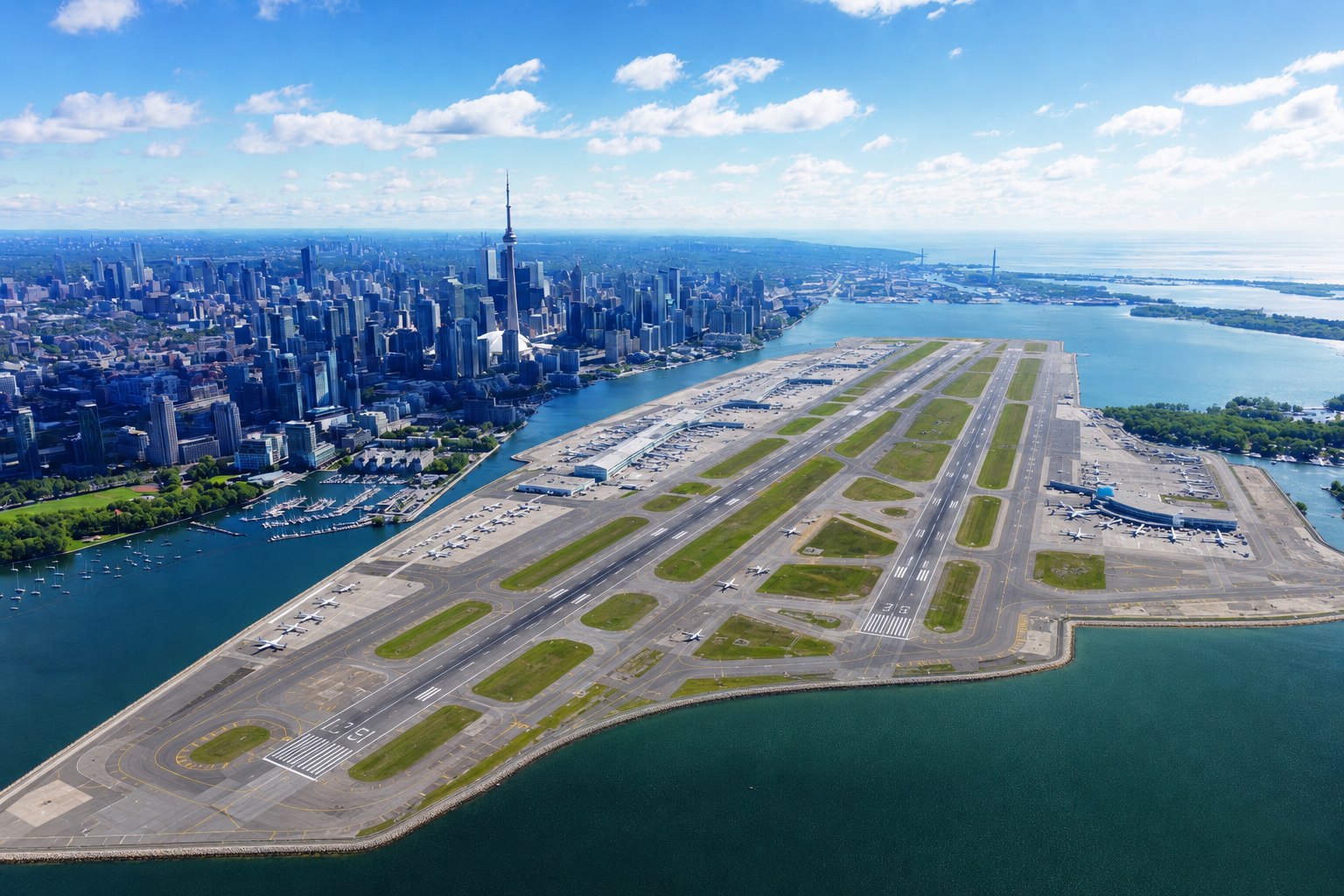
Billy Bishop is currently valued as a small, convenient downtown boutique airport. Increasing its capacity to 10 million passengers would not simply preserve the airport with a few improvements. It would require a much larger aviation operation—and commit Toronto’s harbour to that future for generations.
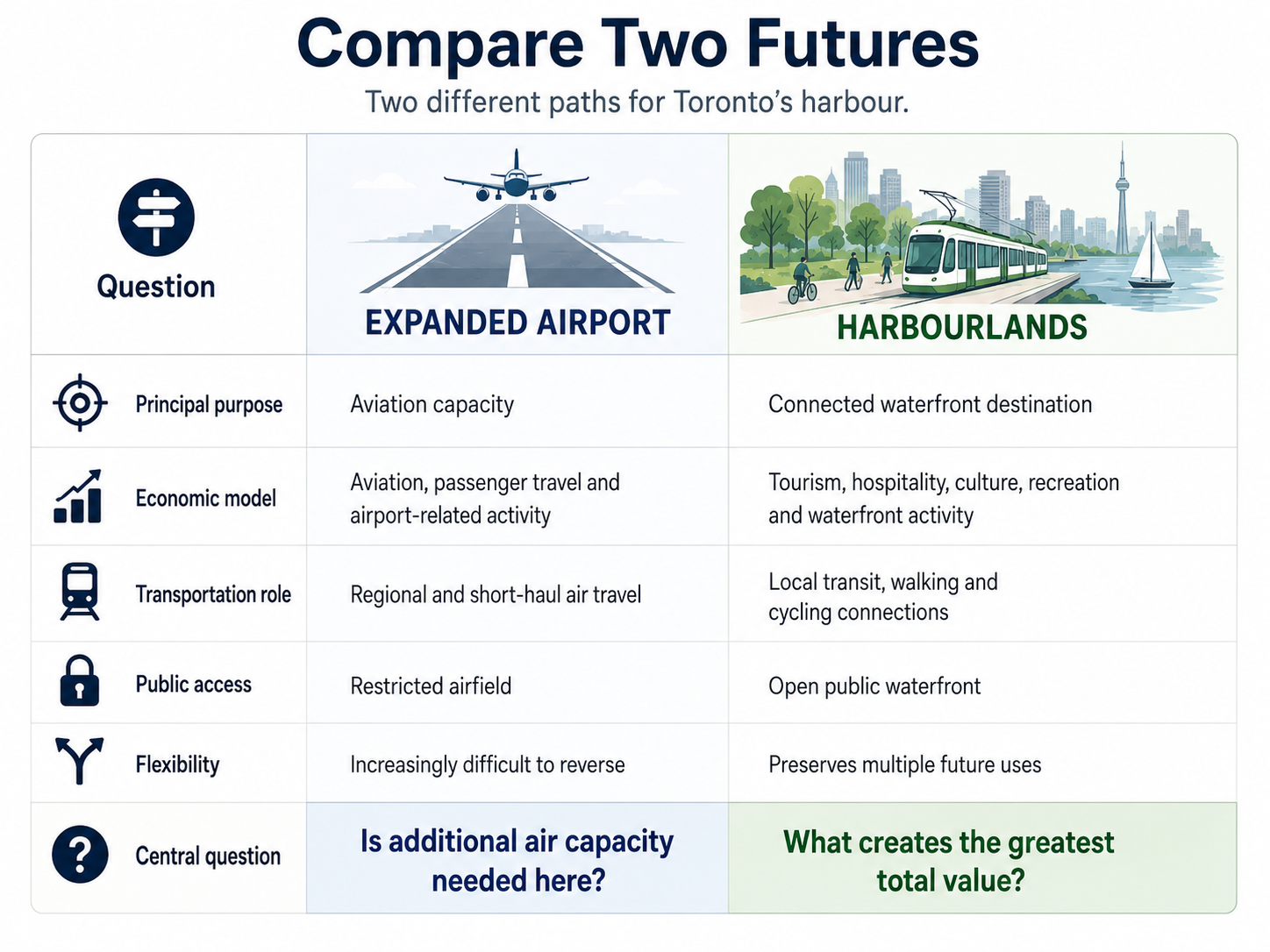
Before making that commitment, governments must prove that expansion creates more net public value than the Harbourlands alternative it would prevent.
A fivefold expansion of Billy Bishop would place sustained pressure on the harbour, airport access, nearby communities and the public waterfront. It would also make the airport’s continued growth a defining feature of future waterfront planning.
Jets, longer runways, and dramatically higher passenger volumes would create demand for larger terminals, as well as servicing and ground-access infrastructure. Once billions are committed, each investment would create a rationale for the next.
1.7 million
Passengers in 2025
10 million
Proposed annual capacity
Nearly 6×
Recent passenger traffic
One
Irreplaceable downtown harbour
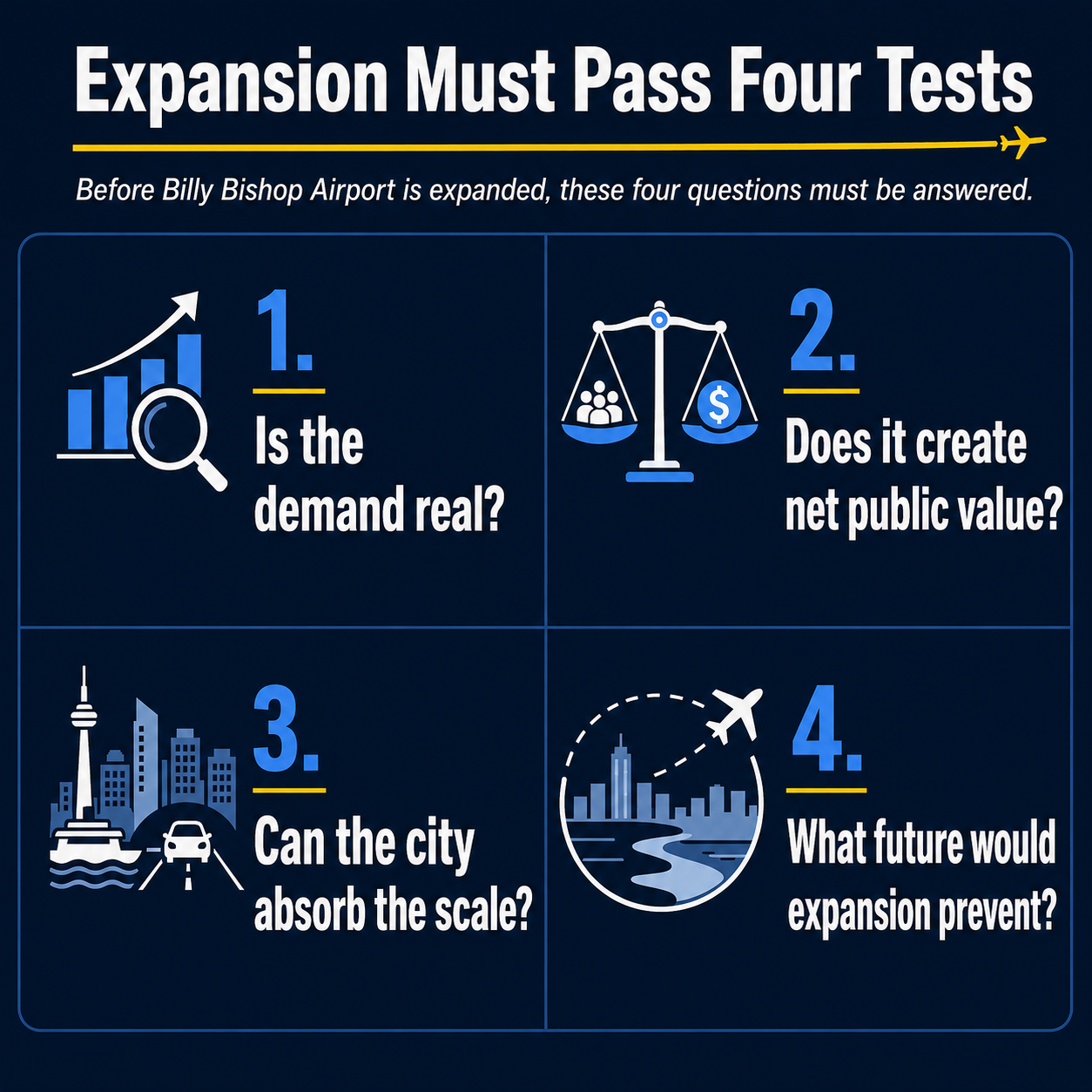
1. Is the demand real?
A goal of 10 million passengers is not itself a demand forecast. The business case should identify the airlines, routes and passenger markets expected to support that volume—and distinguish new travel from passengers shifted from Pearson. It must also consider how high-speed rail could affect demand for short-haul flights.
2. Does it create net public value?
More airport activity does not automatically mean more net economic value. The analysis must include public infrastructure, congestion, environmental and mitigation costs, and determine who receives the benefits. Expansion must also be compared against the economic value of the Harbourlands alternative—not against leaving the land unchanged.
3. Can the city absorb the scale?
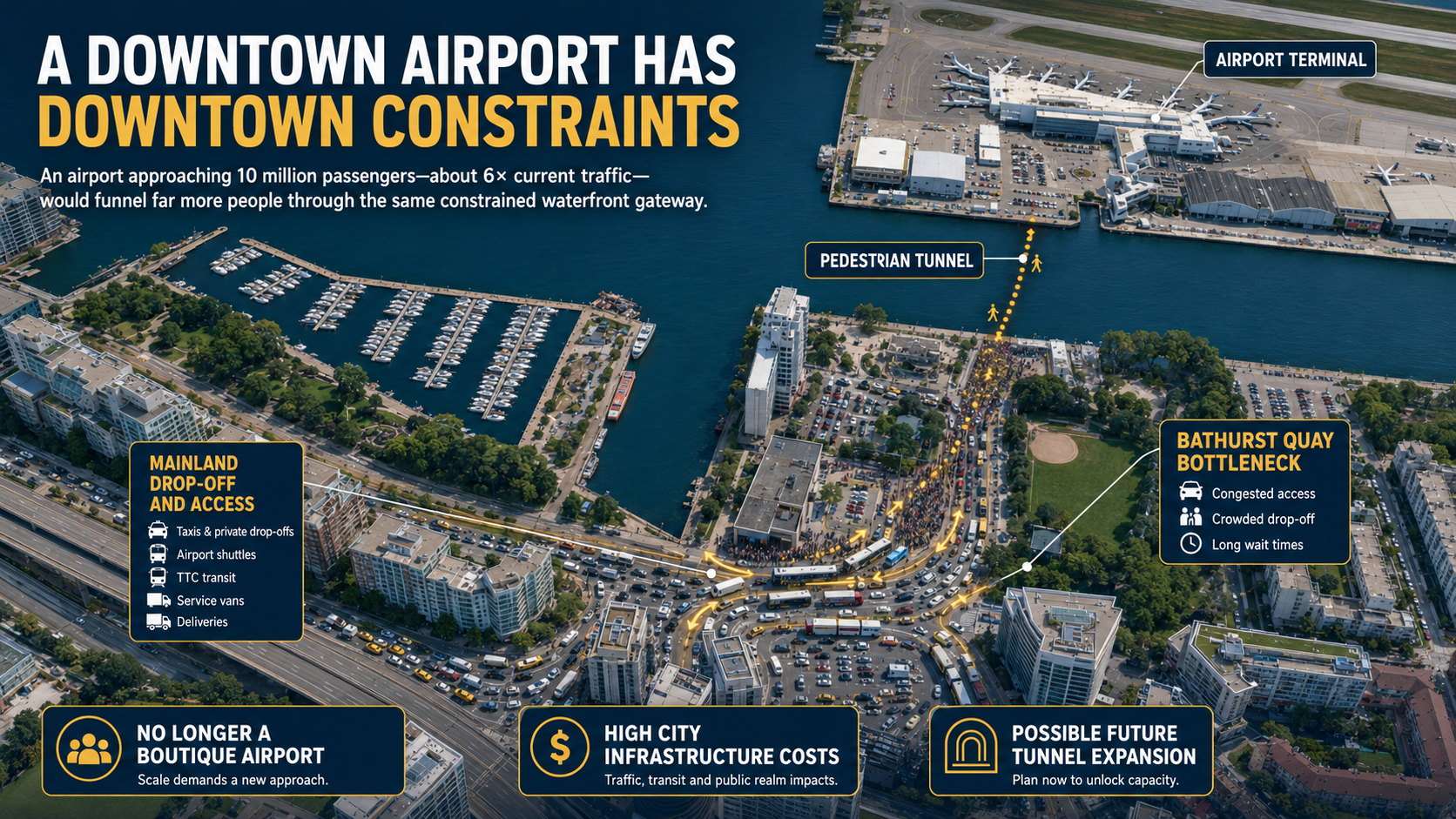
A downtown airport approaching 10 million passengers would push far more travellers, taxis, shuttles, service vehicles and deliveries through Bathurst Quay. The business case must show how the streets, curb space, transit, ferry, tunnel and terminal could handle that volume without eliminating the convenience used to justify expansion.
4. What future would expansion prevent?
Expansion would commit capital, infrastructure and public policy to continued aviation use. That would make the connected Harbourlands waterfront increasingly difficult—perhaps impossible—to realize. Some parkland could remain near a larger airport, but the airport would continue to occupy the missing link required by the Harbourlands vision.
A downtown airport has downtown constraints.
An airport approaching 10 million passengers would have to accommodate nearly six times the recent passenger traffic through the same constrained waterfront gateway. The business case must show how the tunnel, ferry, terminal, taxis, shuttles, public transit, service vehicles, and surrounding streets would handle that volume without destroying the convenience that justified the expansion.
The analysis should determine whether the existing pedestrian tunnel could accommodate the projected passenger volumes—or whether costly expansion or additional access infrastructure would be required.