The Billy Bishop Decision
The expansion proposal has been rejected. The long-term question remains.
On July 24, 2026, the federal government announced that it would not pursue the proposed expansion of Billy Bishop Airport and would focus exclusively on the approved runway-safety work now underway.
The decision cited concerns about public spaces, noise, environmental impacts, housing and the interests of Toronto residents.
It was an important decision—but not a decision to close the airport or create the Harbourlands. The airport remains open, its safety project continues, and the Province of Ontario continues to advocate for expansion.
The decision preserved Toronto’s options. The next task is to examine them.
What was decided
Ottawa will not presently pursue the proposed longer operational runway and jet expansion.
Approved airport safety work will continue.
Public-space, environmental, noise and housing considerations must shape future discussions.
What was not decided
The airport was not closed.
Harbourlands was not approved.
Ontario has not withdrawn its expansion ambitions.
No process has yet been established to evaluate a post-airport future.
1.7 million
Passengers in 2025
10 million
Proposed annual capacity
Nearly 6×
Recent passenger traffic
One
Irreplaceable downtown harbour
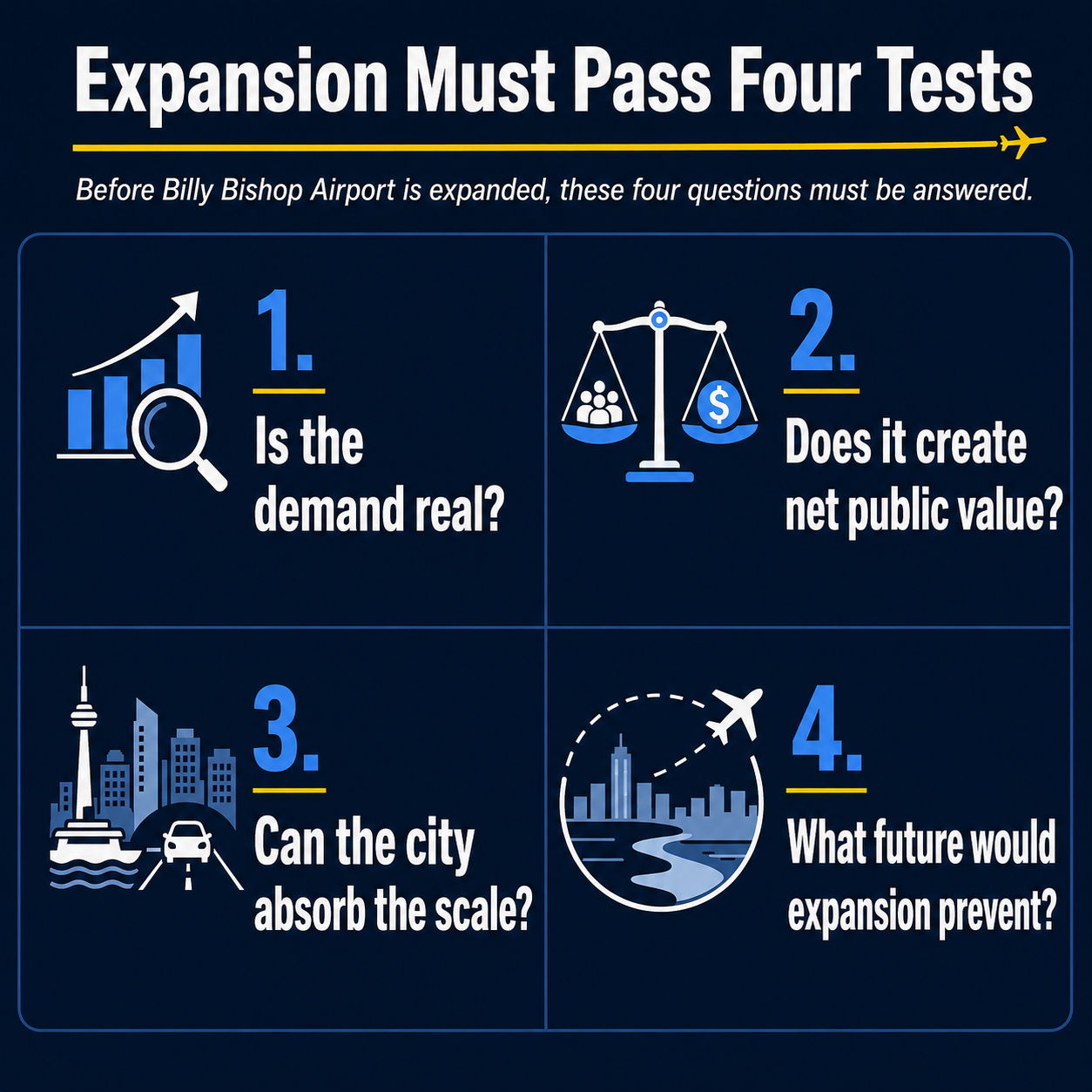
1. Is the demand real?
A goal of 10 million passengers is not itself a demand forecast. The business case should identify the airlines, routes and passenger markets expected to support that volume—and distinguish new travel from passengers shifted from Pearson. It must also consider how high-speed rail could affect demand for short-haul flights.
2. Does it create net public value?
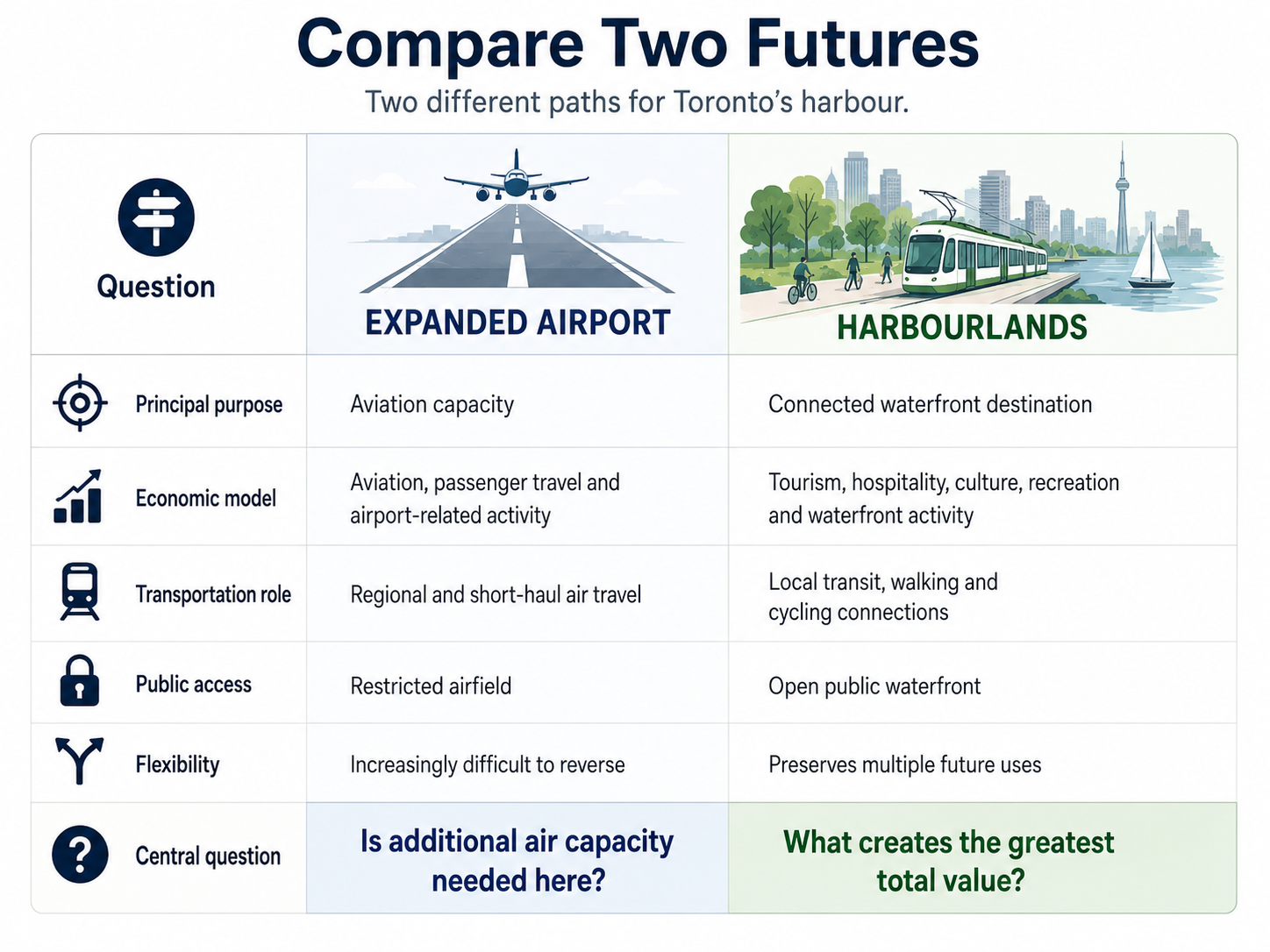
More airport activity does not automatically mean more net economic value. The analysis must include public infrastructure, congestion, environmental and mitigation costs, and determine who receives the benefits. Expansion must also be compared against the economic value of the Harbourlands alternative—not against leaving the land unchanged.
3. Can the city absorb the scale?
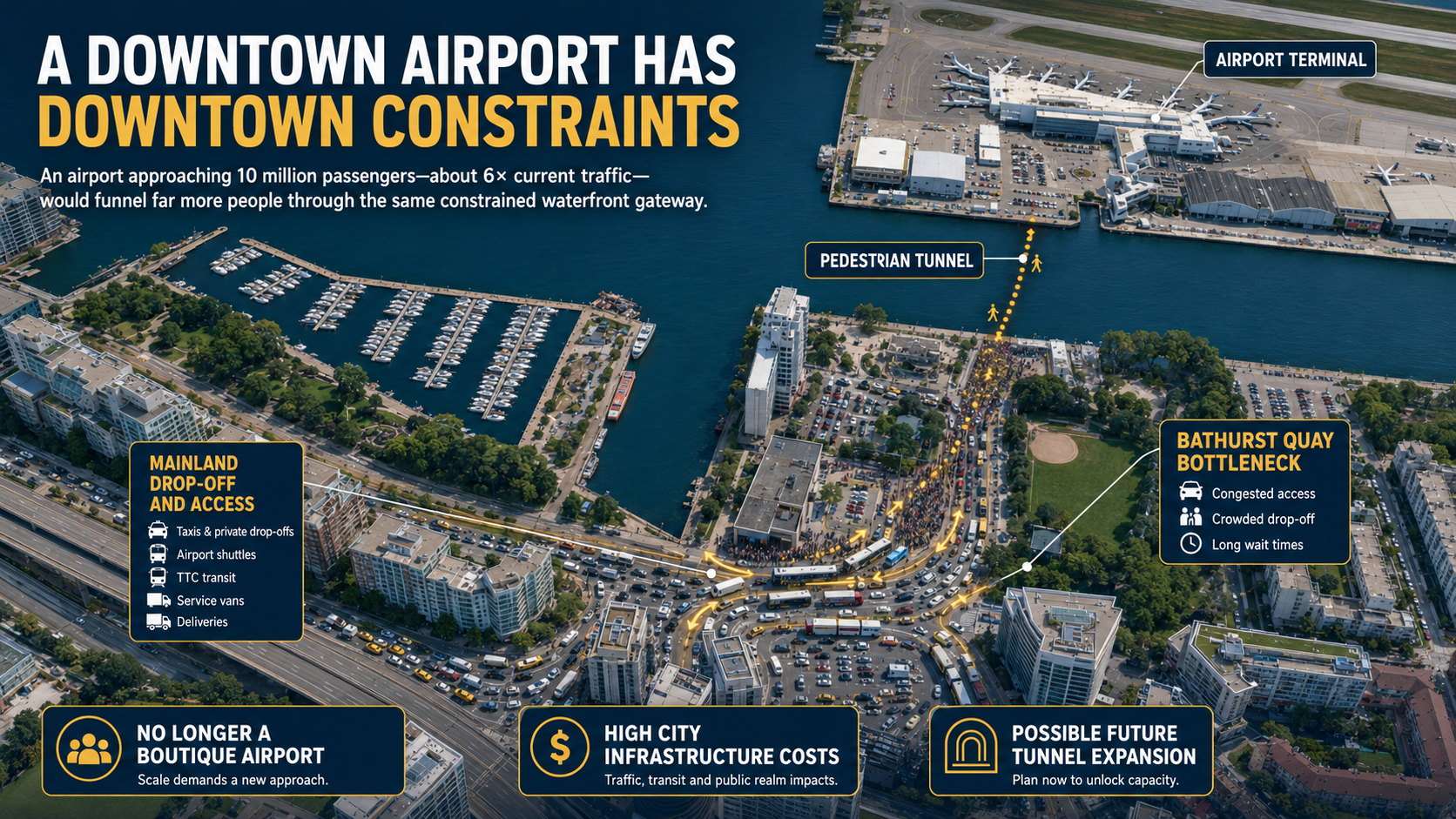
A downtown airport approaching 10 million passengers would push far more travellers, taxis, shuttles, service vehicles and deliveries through Bathurst Quay. The business case must show how the streets, curb space, transit, ferry, tunnel and terminal could handle that volume without eliminating the convenience used to justify expansion.
4. What future would expansion prevent?
Expansion would commit capital, infrastructure and public policy to continued aviation use. That would make the connected Harbourlands waterfront increasingly difficult—perhaps impossible—to realize. Some parkland could remain near a larger airport, but the airport would continue to occupy the missing link required by the Harbourlands vision.
These were the central public-value questions raised during the 2026 debate on Billy Bishop expansion.
The absence of a detailed expansion plan or a comparative business case made it impossible to provide a satisfactory answer.
A downtown airport has downtown constraints.
An airport approaching 10 million passengers would have had to accommodate nearly six times the recent passenger traffic through the same constrained waterfront gateway. The business case needed to show how the tunnel, ferry, terminal, taxis, shuttles, public transit, service vehicles, and surrounding streets would handle that volume without destroying the convenience that justified the expansion.
Had there been an analysis, it should have determined whether the existing pedestrian tunnel could accommodate the projected passenger volumes, or whether costly expansion or additional access infrastructure would have been required.